
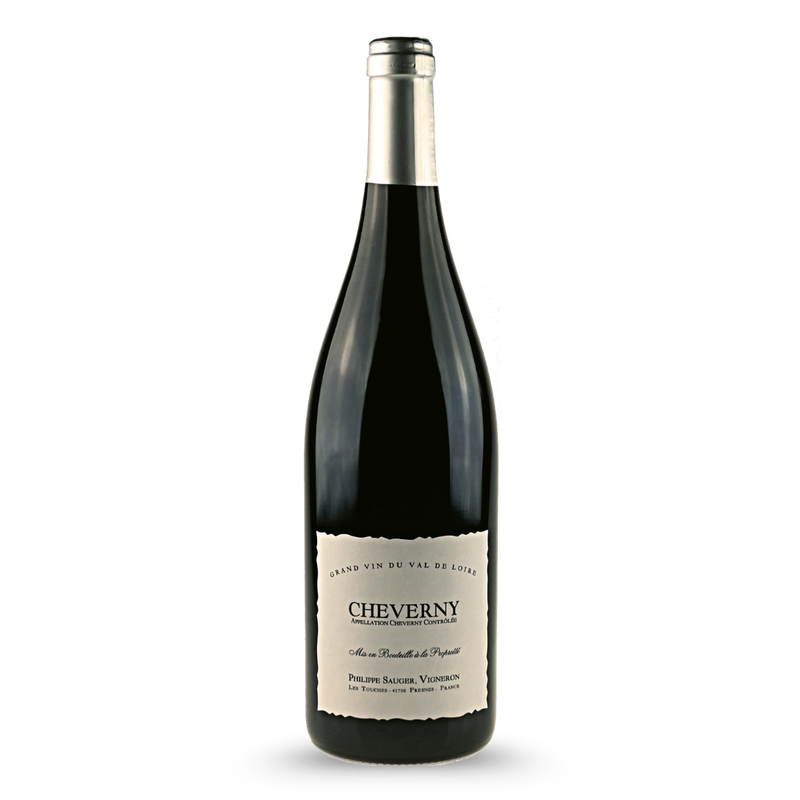


Philippe Sauger Cheverny Rouge 2024 is a supple red Loire wine from the AOC Cheverny, made from Pinot Noir, Gamay, and a small amount of Côt. This blend perfectly suits the style of Cheverny: fresh, fruity, and lightly spiced, with Pinot Noir for finesse and Gamay for juiciness. The wine comes from Domaine Sauger in Fresnes, a family business that has been active since 1870 in the region surrounding the castles of Cheverny, Chambord, Blois, and Chenonceaux.
Cheverny is located in the Loire, between the river and the Sologne, where coolness, forest influence, and light soils ensure fresh, fruity wines.
• Location / Origin: Domaine Sauger is situated on the left bank of the Loire, in the heart of Loir-et-Cher. Its proximity to the Sologne gives the wine its fresh, accessible Loire character.
• Appellation: What is AOC Cheverny? Cheverny is an appellation in the Loire where red wines are always made from a blend, with Pinot Noir as the primary grape and Gamay as an important addition.
• Soil: The vines grow on sandy clay soils. This relatively light soil helps to keep the wine fresh, fruity, and supple.
• Yield: The yield is around 60 hl per hectare. That fits the accessible, fruit-forward style of this Cheverny Rouge.
This red Cheverny is made from 3 grape varieties.
• 70% Pinot Noir – Cheverny: Pinot Noir forms the basis of the blend and gives the wine finesse, fresh red fruit, and a soft structure.
• 25% Gamay – Cheverny: Gamay brings extra juiciness, freshness, and easy-drinking pleasure. This grape makes the wine lively and immediately accessible.
• 5% Côt – Cheverny: Côt, also known as Malbec, provides a small addition of color, spiciness, and structure.
Vinification is focused on pure fruit, supple tannins, and the preservation of freshness.
• Harvest & Selection: The grapes are harvested at optimal ripeness and selected both in the vineyard and in the cellar. This keeps the base of the wine clean and fruit-forward.
• Fermentation: Each grape variety is vinified separately. Maceration lasts 8–12 days at 28 °C, with duration and pump-overs adjusted per variety.
• Pressing & Malolactic fermentation: After draining the wine, a gentle pressing and malolactic fermentation follow at 18–20 °C. This rounds out the acidity and gives the wine a suppler structure.
• Aging: The wine ages for 4–6 months in stainless steel tanks. This keeps the red fruit clearly present, without any oak influence.


