
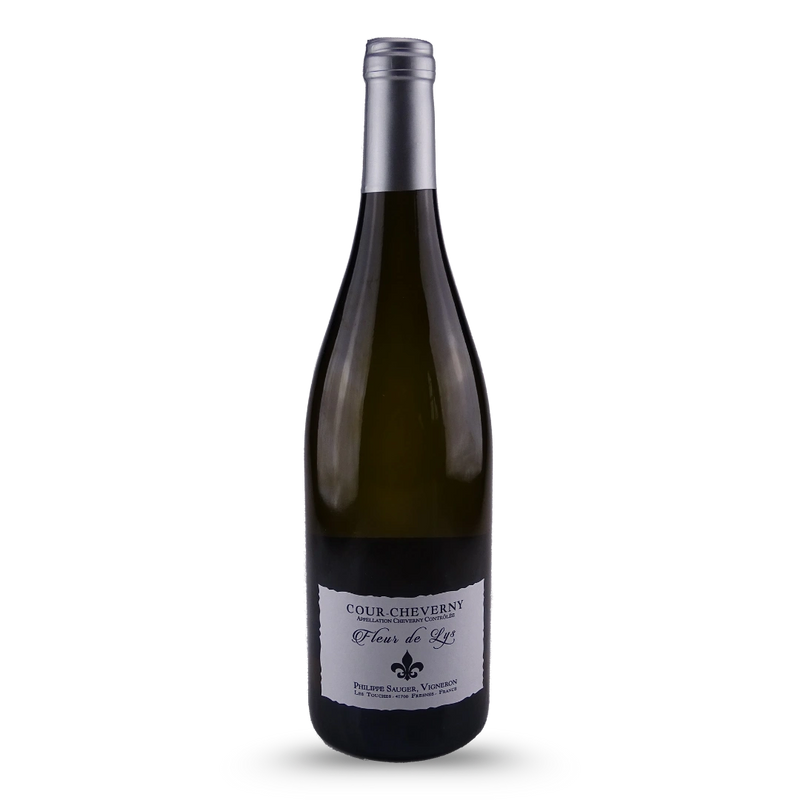


Philippe Sauger Cour-Cheverny Fleur de Lys 2022 is a dry white Loire wine made from 100% Romorantin, the local grape inextricably linked to Cour-Cheverny. This wine comes from Domaine Sauger in Fresnes, a family business operating since 1870 and now spanning 5 generations. Romorantin ripens late, is hand-harvested here, and produces a wine with honey, acacia, lively freshness, and remarkable length.
Cour-Cheverny is located in the Loire, in the vicinity of the castles of Chambord, Cheverny, Blois, and Chenonceaux.
• Location and origin: Domaine Sauger is located in Fresnes, south of the Loire and on the edge of the Sologne. This location gives the wine a fresh, elegant Loire signature.
• Appellation: What is Cour-Cheverny? Cour-Cheverny is an appellation for white wine made from Romorantin, a local grape that produces a lively, original, and age-worthy style here.
• Soil: The vines grow on sandy clay soils. This soil is well-suited to Romorantin and helps the wine achieve freshness, tension, and subtle aromatic complexity.
• Climate: The climate is oceanic with a moderate summer. The influence of the Sologne and the surrounding forests helps to keep the wines fresh and precise.
• Harvest: Romorantin ripens late and is hand-harvested at optimal ripeness. This preserves the balance between ripe fruit, freshness, and structure.
This Cour-Cheverny is made entirely from Romorantin.
• 100% Romorantin – Cour-Cheverny: Romorantin is a local Loire grape that produces wines with lively acidity, honeyed aromas, acacia, and a long finish. The grape can be fresh and subtle when young but is also known for its good aging potential.
The vinification focuses on fruit, aromatic purity, and preserving freshness.
• Pressing and skin contact: The grapes are pressed directly, with a light skin maceration. This short skin maceration helps extract more fruit and aroma from the grapes.
• Fermentation: The wine is vinified in temperature-controlled stainless steel tanks. This keeps the fresh, floral, and honeyed notes of Romorantin clear and present.
• Yield: The yield is around 50 hl per hectare. This is typical for a dry white Loire wine where freshness, purity, and length are key.
• Aging potential: This Cour-Cheverny can easily be aged for 10–15 years. When young, the wine is lively and subtle; with bottle aging, it develops more depth and gastronomic breadth.


