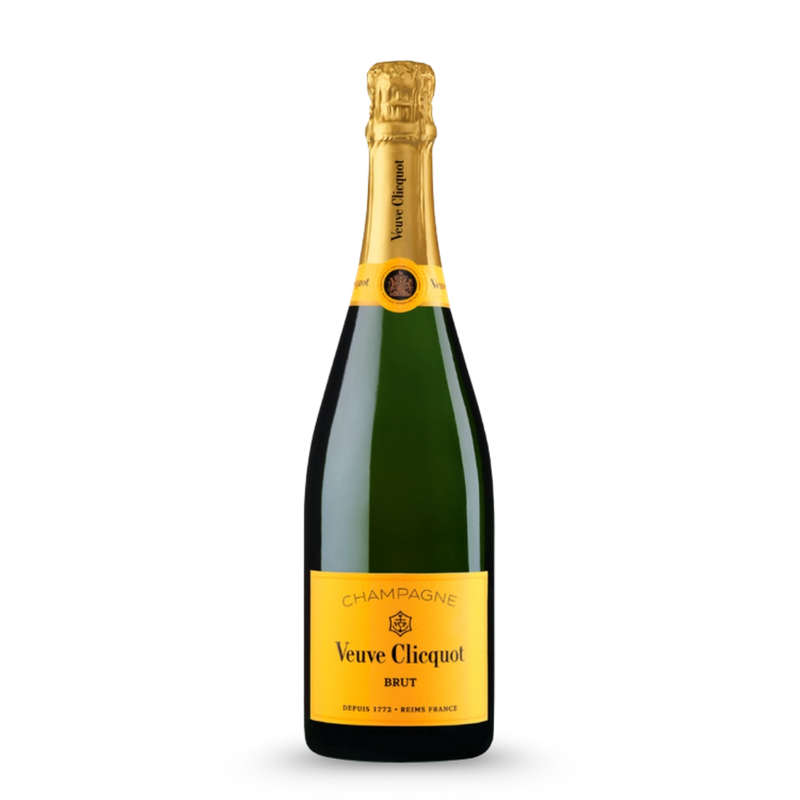
Veuve Clicquot Brut Champagne

The yellow label stands for a distinct style: Veuve Clicquot Brut Champagne combines a full, dry taste with fresh tension and a creamy mousse. This Yellow Label is the signature house cuvée, in which the winemakers preserve the recognizable character of Veuve Clicquot from year to year. The diversity of Champagne gi... Read more
Size 0.75L
Aromas & flavours
Ripe white fruit Citrus Raisins Brioche Vanilla
Full tasting details ↓

55,95
Number of bottles Total 55,95
9 bottles in stock
Delivery in the Netherlands & Belgium
Free collection in Berkel-Enschot · today
Free PostNL delivery Free Trunkrs delivery
Secure payment with
iDEAL Wero Bancontact Mastercard Visa Apple Pay Google Pay American Express Maestro PayPal

How this wine tastes

Explore the flavour profile, food pairings and tips for serving and cellaring.

Flavour profile

Golden yellow in the glass, with fine, persistent bubbles and scents of pear, peach, citrus, and brioche. The taste is full and dry, with a creamy mousse and lively acidity. Ripe fruit and a subtle hint of dried fruit accompany the persistent finish.

Complexity
Complex & deep

Aromas & flavours

Grape & vineyard

Ripe white fruit Citrus Raisins

Winemaking & ageing

Brioche Vanilla

From vineyard to bottle

The origin, grapes and craftsmanship behind this wine.

The yellow label stands for a distinct style: Veuve Clicquot Brut Champagne combines a full, dry taste with fresh tension and a creamy mousse. This Yellow Label is the signature house cuvée, in which the winemakers preserve the recognizable character of Veuve Clicquot from year to year.

The diversity of Champagne gives the winemakers a broad palette of base wines.

  • Location / origin: Yellow Label unites wines from 50–60 different crus, or wine-growing villages, within the Champagne region in northeastern France. The champagne house is based in Reims.
  • Climate & influences: The region experiences both oceanic and continental influences. Its northern location helps the grapes retain their natural acidity during ripening, an important foundation for champagne.
  • Soil: The Champagne region features many calcareous soils, including chalk and marl. The porous chalk drains excess water while simultaneously holding a reserve that the vines can access during dry periods.

The base wines are made separately by grape variety and origin.

  • Harvest & pressing: The grapes are harvested by hand and pressed as whole bunches. This careful processing helps keep the juice clear and preserves the fresh fruit aromas.
  • Fermentation & blending: The first fermentation takes place in stainless steel tanks at 18 °C and lasts 8–10 days. The base wines are then blended with reserve wines from previous vintages, which provide extra depth and support the continuity of the house style.
  • Second fermentation: After the addition of yeast and sugar, a second fermentation follows in the sealed bottle. The carbon dioxide created during this process remains dissolved in the wine and later forms the mousse.
  • Bottle aging: The champagne matures for at least 30 months on the lees in the chalk cellars of Reims. This prolonged yeast contact contributes to the soft texture and aromas of brioche.
  • Dosage & rest: After removing the yeast sediment, Yellow Label receives a dosage of 9 g/l. This is followed by at least 6 months of bottle rest, allowing the wine to further balance out.

The proportions vary per blend; each grape fulfills its own role.

  • 50–55% Pinot Noir – Champagne: Provides structure, power, and depth.
  • 28–33% Chardonnay – Champagne: Brings finesse and elegance.
  • 15–20% Meunier – Champagne: Ensures roundness and a smooth connection between the other grapes.
Veuve Clicquot
The wineryVeuve Clicquot Champagne · France

  • 4.3 stars, Vivino: The non-vintage version receives this rating based on 149,400+ reviews.
Veuve Clicquot

More about Veuve Clicquot

‘Veuve’ means widow and refers to Barbe-Nicole Clicquot-Ponsardin. When her husband passed away in 1805, she took over the management of the house that her father-in-law, Philippe Clicquot, had founded in 1772 at the age of 27. Her drive for innovation changed champagne production: with the 1816 riddling table, yeast sediment could be precisely moved to the bottle neck and subsequently removed. In doing so, she made clear champagne possible using a method that other houses subsequently adopted.

Discover the winery

Herkomst & details

The wine’s characteristics, origin and practical details.

The wine

Champagne · Pinot Noir, Meunier, Chardonnay
Wine type
Champagne
Wine category
Champagne
Varietal(s)
Pinot Noir , Meunier , Chardonnay
Vintage
-
Size
0.75 L
Alcohol content
12.0%
Closure
-

Origin & winery

France · Champagne
Producer
Veuve Clicquot
Country
France
Region
Champagne
Appellation
Reims

Terroir & maturation

-
Soil
-
Maturation
-
Oak aged
-
Single grape variety
-
Sparkling
Yes
Malolactic conversion
Yes
Taste style
Champagne

Serving & cellaring

Oysters, Fried food
Ideal serving temperature
8° - 10°C
Drinking Window
2024–2034
Food Pairing
Oysters,
Fried food

Reviews from wine lovers

Read experiences with Veuve Clicquot Brut Champagne or write your own review.

Get 5% off

  • Be first to hear about new offers
  • Exclusive discounts for subscribers
  • Your personal welcome discount

You are subscribing to our newsletter. You can unsubscribe at any time. Privacy policy